
Wood
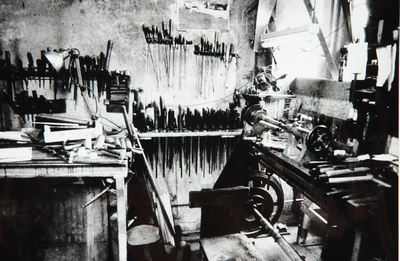
Workshop of J. and R. Glen, Highland Bagpipe Makers, 1970s
The workshop depicted in this black and white photograph contains the tools and equipment used by several generations of instrument makers at the J. and R. Glen Highland Bagpipe Makers, Edinburgh. Spoon bits, turning chisels, and reamers of various sizes can be seen mounted on the wall next to a mechanised table-top lathe which was used for boring hollows and shaping the pipes of the hand-crafted instruments made at the workshop until the business closed after over 150 years in Edinburgh.
Thomas McBean Glen (1804-1873) founded the business in 1826 in the Cowgate in Edinburgh’s Old Town. The shop first opened as a dealer in second-hand instruments but by 1833 Glen is listed in the Edinburgh Post Office directory as a pipe and flute maker. Thomas’s brother Alexander brought the bagpipe making skills to the business which was taken over by Thomas’ sons John Glen (1833-1904) and Robert Glen (1835-1911) in 1866. The workshop moved to several addresses in the Old Town before settling in 1911 at 497 Lawnmarket, at which time Andrew McKay Ross, a relative of the Glens, joined the workshop as a bagpipe maker. In the early years of the century the brothers reputedly employed up to six men, including two French violin makers.
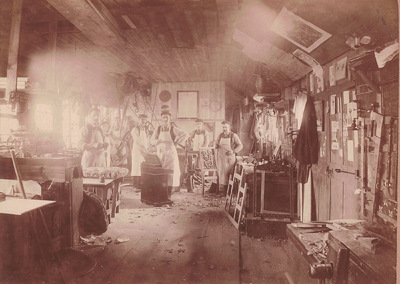
Danny Thompson’s Cabinet Makers Workshop, Tain, ca. 1890
This photograph shows the interior of Danny Thompson's cabinet makers workshop in Upper King Street, Tain in Ross-shire. It shows six men, a typical workshop size, all wearing white aprons, with the proprietor stood in the center. The figure in the background on the left appears to be a teenage apprentice. The workshop is a simple, single-story wooden building. Another view taken from outside about ten years later shows it adjoining a windowed building that acted as a showroom. The firm was founded by Danny Thompson, a local man, in the 1880s, but was sold to William Fraser, who appears on the left of the photograph, in the early twentieth century. Fraser retained the original name and D. Thompson & Co. continued in existence through several ownerships to 1994.
A number of partly finished objects can be identified in the photograph, including picture and mirror frames, a carved chair back and hall-stand or mirror back. The local museum in Tain has a carved chair attributed to Danny Thompson that is very similar to the one displayed here. Upholstered cushions and textiles can be seen on the left. Danny Thompson, the master craftsman and proprietor, is stood behind a lady’s davenport writing desk, which was a complex and expensive piece of furniture made for elite customers. These items have been arranged in the image for narrative effect and to show the range of products made. It is unlikely that tasks like upholstery work were normally undertaken in such a dusty environment as is evident here. To the rear of the workshop, fixed to the roof, is a wheel with a mechanized belt-drive, for running a sawing or turning machine and there are numerous hand tools in racks on the wall. Wood is stored above in the rafters and prints and designs are pasted onto the walls and ceiling. In common with most local workshops of this type, Thompson also made coffins, though none are visible in this image and he fitted out house interiors with wood paneling and chimney pieces. One of his most notable commissions was Morangie House (now a hotel) on the outskirts of Tain, an eight-bedroom mansion designed by architect Andrew Maitland of Keith in Banffshire for the wealthy widow of a local farmer, on which he and his men worked extensively in 1902-3.