
Buildings
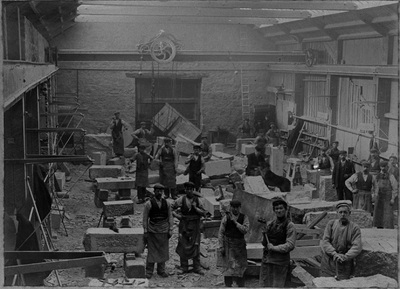
Masons in Erran Granite Works, Aberdeen, ca. 1890
This photograph of stonemasons at work in the Erran Granite Works in Canal Street, Aberdeen, shows them working in an open-top shed equipped with a pulley but no other machinery. The men hold various hand tools including granite picks and bush hammers used for texturing the surfaces of stone. Almost all the masons are in shirt sleeves and wear aprons, though some have hung jackets on the long hooks leaning against the left wall in an attempt to keep them clean from the dust generated from dressing the granite slabs, seen here supported on stone pedestals.
Aberdeen and its districts are geologically rich in granite and were at the centre of Scottish stone quarrying and finishing in the late nineteenth century. More than 20 granite merchants are listed in the Aberdeen Post Office directory for 1890. They supplied the stone for major building works but also for subsidiary trades such as stonecutting and polishing. The Erran Works was in Canal Street to the east end of the city where at the peak of production there were more than forty-six granite firms.

Wheelwright’s Workshop, Fala Dam, Midlothian, ca. 1890
This wheelwright’s workshop in the hamlet of Fala Dam in a rich agricultural area about twelve miles south of Edinburgh, is a stone-built, pan-tiled structure on two floors with a cottage at one end. It is part of a terrace of cottages, shops and workshops. The roof tiles suggest it was constructed in the later eighteenth century. The wide central entrance and opening above reveal the building’s specialist functions for storing the wood and components of carts and other related goods (such as wheel barrows), with the yard in front given over to the construction or repair, as here, of large wheeled vehicles. There would have been a forge nearby for making the iron components and tyres. Three men are visible in this image, which seems to have been taken in high summer. Another photograph of the same workshop a few years earlier has four men posing outside holding their wood working tools, with rolled-up sleeves and aprons. A great deal of the work undertaken was probably out-of-doors. Indeed, the dismantled cart that dominates this image is so large it could only have been built in a yard.
This is one of several photographs of the workshop that was taken in the late nineteenth century, with variations in the extent of the foliage growing on the building and on the wooden railings suggesting a wide span of years. A photographic postcard from the 1930s also shows the same row of quaint cottages, with the workshop still visible, in a hamlet that was clearly attractive to tourists. Some of the contents of the joiner’s house were donated to the National Museums of Scotland in the 1960s. The buildings still exist today, though are now all converted into smart houses.