
Metal Wares
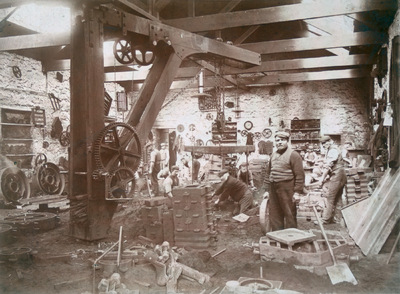
Alexander Jack & Sons, Agricultural Implement Maker, ca.1885
This image shows the ‘pattern shop’ and foundry at the agricultural implement making firm of Alexander Jack & Sons of Maybole in Ayrshire in the mid 1880s. It is one of a series of photograph of the different departments of the firm, which employed up to a 150 men at its height in the first decade of the twentieth century, many of them skilled craftsmen. In the foreground are some of the molding boxes, blocks and sand that are used for making metal castings, with a wide variety of patterns and models stored and displayed along the walls. Castings were made here in both iron and brass, with some of great weight, hence the iron rig and pulley system for lifting that is seen in the middle of the image. The rotund figure facing the camera is probably the foreman, who would have been a skilled blacksmith or iron founder and there are another eleven men at work in the image. Though this was a workshop on a large scale with some mechanisation, according to local report ‘old craft and new machines work hand-in-hand.’
The firm was founded by small-town craftsman, Alexander Jack, who started as a joiner and cabinet maker in a business that soon failed. But ever the entrepreneur, from 1852, with only limited capital, Jack began making small tools for other craftsmen and soon expanded into agricultural implements and vehicles making, taking advantage of the local demand from farming and the nearby railway line for transport to markets beyond Ayrshire. Jack’s business partner and successor was John Marshall, an engineer, who also became Provost of Maybole and served as President of the Society of Scottish Agricultural Engineers. The firm, which gained many prizes at exhibitions, survived to 1966.
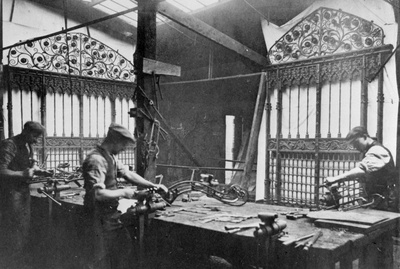
Thomas Hadden’s workshop, Edinburgh, ca.1910
This photograph shows three smiths working on the wrought iron gates designed by architect Robert Lorimer for the Thistle Chapel in Edinburgh’s St Giles Cathedral. The men are using hand tools and bench-fixed vices to shape the gate’s iron fretwork. The smith to the right is working on its interlocking lower section while the other two are using hammers and metal files to shape curved and lattice forms. Two finished sections of the gates can be seen leaning against the workshop walls.
The chapel was designed as a commission from the Trustees of The Order of the Thistle who wanted to create a meeting place for the Knights of the Order of the Thistle in a building that embodied nationalist spirit. When the commission was awarded to Lorimer in 1909 the Trustees stipulated that Scottish craftsmen should carry out as much of the work as possible. Hadden provided the metal door furniture and gates, the firm of W & A Clow carved the ornate choir stalls; Phoebe Traquair and Whytock and Reid were other Edinburgh-based contributors.. The Chapel’s granite and marble floor was the work of James Allen & Sons of Piershill, and the coloured glass the work of Aberdeen glass-stainer Douglas Strachan. On its completion in 1911 the Thistle Chapel represented the very best in Scottish craftsmanship in stonework, metal work and woodcarving.