
Glass and Ceramics
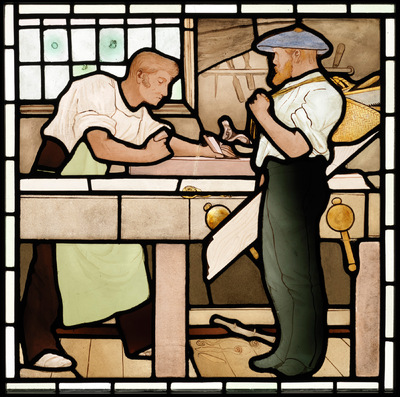
Stained glass panel, 'The Joiners', Stephen Adam, 1878
This stained glass panel is one of twenty depicting different trades created by Stephen Adam (1848-1910) for the Burgh Halls in Maryhill a western suburb of Glasgow. Adam was one of Scotland’s most prolific and renowned nineteenth-century stained glass designers. His Maryhill panels celebrate the artisan labour that defined the industries of Glasgow and Maryhill’s local trades. This panel depicts a typical joiner’s workshop. One man wears a traditional Scotch bonnet and carries a basket of tools that include a handsaw and piece of rope, while the other planes a piece of timber on a workbench. The tools and equipment seen here would have been familiar to most woodworker’s workshops in the 1870s. The Maryhill Burgh panels have been noted for their contemporary realism in contrast to Renaissance-style depictions of figures that were favoured for most late nineteenth-century ecclesiastical stained glass. Other Glasgow trades featured in Adam’s panels include zinc spelters, iron moulders and chemical workers.
Adam’s own workshops at St Vincent Street, Glasgow, feature in an 1891 published account titled Glasgow and its Environs. The description gives a sense of the hierarchy of tasks and division of labour involved in making architectural stained glass, describing workshops for lead working, drawing and designing cartoons, for glass painting and staining, plus kilns for firing and supplementary departments for packing and for housing stocks of materials. At the height of his success in the 1890s Adam employed several assistants and apprentices.
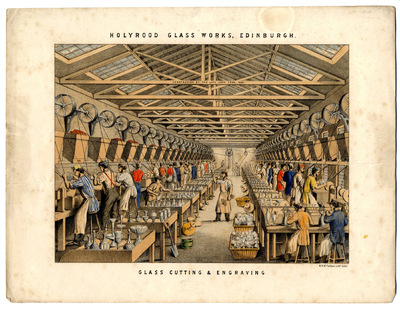
Cutting and Engraving Shop, Holyrood Flint Glass Co, ca. 1860
This workshop in the Cannongate area of Edinburgh, part of a bigger enterprise known as the Holyrood Flint Glass Company, was for the finishing of high quality glasswares using skilled cutting and engraving techniques. It shows a mixture of machine technologies for powering the cutting wheels combined with apprentice-trained handwork. The workshop is lit from above and contains about forty wheels attended by as many craftsmen. The engravers, fewer in number, can be seen in the foreground to the right, with their smaller precision engraving tools powered by hand or by a foot treadle. Much of the engraving work undertaken for the firm was done elsewhere in sub-contracting workshops in nearby Abbeyhill, mainly staffed by Bohemian glass engravers famed for their skill and innovative design. The Holyrood Glass Co. also made more pedestrian wares for a mass market in their factory premises.
The output of the workshop illustrated here, which was probably drawn for use in a catalogue or some other form of promotional literature, comprised a range of predominantly domestic wares which can be seen awaiting the cutting process and also stored in baskets on the floor. Various cutting wheels can also be seen on the floor. The Holyrood Glass Co. was known for its cut glass decanters and table glasses, along with fruit bowls, vases, glass oil lamps and dressing table sets. The company also produced fine glass door handles set with cameo portraits of notable figures of the day. They made to commission and for sale through their own retail premises in central Edinburgh and were frequently attendees at the great exhibitions in Scotland. A heavy glass vessel such as a large bowl could take up to 40 hours of work for the cutting stage.