
Jewellery and Silverware
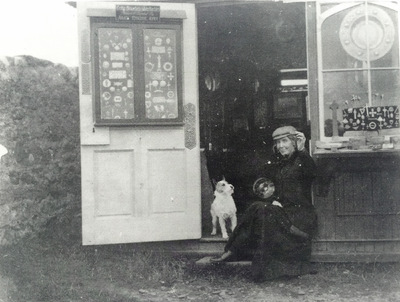
Iona Celtic Art and Euphemia Ritchie, ca. 1900
This is a photograph of Euphemia Ritchie (1862-1941) of Iona Celtic Art with her dog Kim on the front step of her shop in Iona surrounded by jewellery and silverware. Ritchie sits in the doorway of the shop, located just inside the southern gate into Iona’s Nunnery grounds. Tucked up in a scarf and woollen cap, wearing a dark skirt and jacket with black leather boots, she perches on the front step as she holds up a biscuit for Kim. A small bag under her coat probably holds the proceeds from sales of the jewellery and silverware goods that surround her in the shop. On the back of the door is a glass display case containing brooches, pendants and buckles in Scottish-Celtic revivalist designs. A small shelf under the window displays objects in boxes and small pieces of silver jewellery are pinned to a lined board. A large brass metal plate hangs inside the window. Through the open door objects and glass display cases glint in the light. The shop’s prime position within the nunnery grounds, framed by ancient buildings within coastal landscapes, made her goods popular with visitors to the island.
Euphemia and her husband Alexander Ritchie (1856-1941) met at the Glasgow School of Art in the mid-1890s. They married in 1898 and opened the nunnery shop in Alexander’s native Iona in 1900. Iona was popular with tourists seeking escape from urban life through an immersive experience in a small island embedded with ancient myths and legends of the sixth century Saint Columba and the origins of Christianity. The Ritchies drew on the carved stones and crosses of Iona and the West Highlands, along with the illuminated manuscripts of the early monasteries to provide templates for their designs.
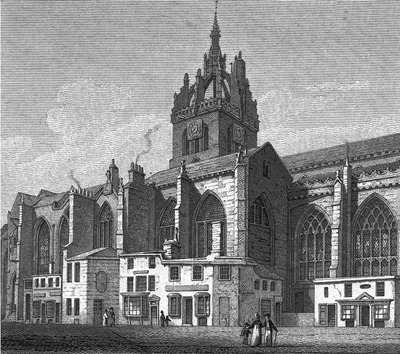
Engraving of Luckenbooths at St. Giles's Church, 1819
This view of St Giles’ Cathedral by London engravers James Sargant Storer (1771-1853) and Henry Sargant Storer (1796-1837) was published in Views in Edinburgh and its Vicinity, (Volume 2) shortly after the parade of small shops in the foreground were demolished to widen the streets of Edinburgh’s Old Town. The shops known as Luckenbooths, or ‘locked booths’ were associated with various small-scale trades, particularly the cheaper end of Edinburgh’s jewellery trade. The booths were a fixture in and around Edinburgh’s Parliament Square from at least the seventeenth century.
An aerial plan of the cathedral, found in the sketchbook of nineteenth-century antiquarian Daniel Wilson, depicts St Giles’ Close in the years 1806-18, includes reference to ‘Luckenbooth Street’ to the north and to small shops belonging to ‘Green the Watchmaker’ and ‘Gordon McKenzie Jeweller’ situated on the south side of the church from which direction this engraving is taken. Luckenbooth Street was demolished in 1802 but the Parliament Square booths remained until 1817. Excavations on the walls of St Giles in preparation for the building of Lorimer’s Thistle Chapel in 1909, revealed the remains of fireplaces and containers for smelting glass in the old Luckenbooth cellars, suggesting that some may have contained small workshops.