
Textiles
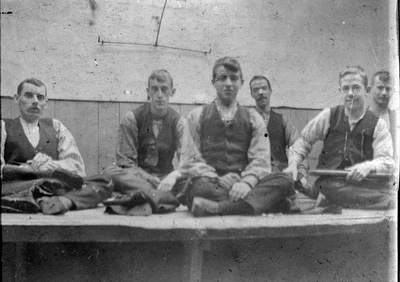
Workshop of Tailor John D. Findlay, Strathaven, ca. 1900
This photograph shows the tailors and apprentices in the workroom of John D. Findlay, Clothier and Gentlemen’s Outfitter, 26 Barn Street, Strathaven. Tailors and their assistants traditionally worked sitting crossed leg on large tables. A raised surface helped to support the weight of heavy woollen fabrics typical to men’s tailoring, and kept garments clean whilst they were being stitched by hand. In earlier centuries tailors sat in the windows of their shops to take advantage of the natural light, however the bare wall in this photograph suggests that Findlay’s men worked in a back room workshop. Despite the smiles of some of the younger men it is a rather bleak depiction of the working conditions of men working in the traditional needle trades.
John Findlay, son of grocer and sometime silk handloom weaver William Findlay, was listed in the 1901 census as a tailor and employer living with his wife Elizabeth at 29 Jamesfield Cottage, Strathaven. Strathaven’s changing fortunes in the last quarter of the nineteenth century likely influenced John’s decision not to follow his father into the weaving trade. The introduction of silk weaving in 1788, followed by the building of a cotton mill in 1790 made Strathaven a textile town throughout the nineteenth century. In 1826, at the peak of production it had 900 working looms and weaving shops could be found in every street of this small South Lanarkshire town. Strathaven continued to thrive by producing textile designers and card cutters when Jacquard looms were introduced, but the mid-century introduction of power-looms undermined the handloom weaving industry. When the railway opened in 1863 younger men sought work outside the village, and by 1900, when John Findlay was 29, there were only 150 looms still at work in Strathaven.
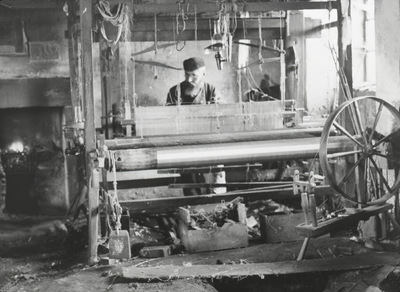
Workshop of a Handloom Weaver, Lanark c.1900
This photograph shows one of the last handloom weavers still practising his trade in Lanark. Taken in 1900, it was reported that only five weavers remained in the town. Just twenty years before there were 140 weavers in Lanark. The last to survive, Mr Thomas Chalmers, died in 1938 aged 84. The passing of the age of the handloom weaver generated much commentary in the early twentieth century with frequent images such as this to represent the idea of simpler times when work and home occupied the same space. The photograph, showing an elderly man at his weaving frame in a cottage or small workshop, is artfully posed. To the left is a hearth and cooking range and in the right foreground is a spinning wheel to suggest the relationship between women’s work and men’s work in a domestic or family setting. The latter has been placed for its narrative effect as it is unlikely that the weaver here processed wool generated within his household. Another version of this photograph showing a second elderly man sat smoking by the fireside on the far left of the image, was published as a commercial postcard for tourists.
Those few handloom weavers who did survive the coming of the factories made highly specialised textiles for the elite fashion industry, much as they do today. In the highlands and islands of Scotland they focused on fine tweeds, with marketing support from bodies like the Highland Home Industries Association. In the village of Stonehouse near Lanark, there were a few specialised silk scarf and handkerchief weavers working on jacquard looms into the 1930s. In numerous villages and small towns in Scotland there are streets of terraced weaver cottages to remind us of the once flourishing state of the craft and its communities.