
Wood
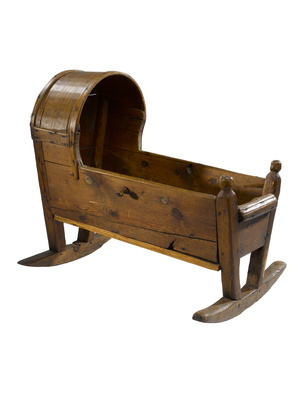
Wooden Cradle, Caithness, late 18th or early 19th century
This simple wooden cradle is constructed of a single piece of wood and topped with a bent wood circular hood. The end-posts cant steeply inwards and extend below the base of the cradle where they are tenoned to broad plain rockers. Simple round finials top the base end-post and the cradle has the marks of three wooden pegs on each side though two of the pegs on one side are missing. It was found in Weydale, a remote settlement in Caithness and probably dates from the late 18th or early 19th century.
Weydale, where this simple cradle was found, is a remote crofting settlement in a valley to the southeast of Thurso, a coastal town known in the late 18th century for its linen production. Weydale was an area defined by its livestock grazing and flagstone quarries. The owner of this cradle may have had it made by a local joiner and it could have been passed down through generations as a family heirloom. Elements of its style and shape were common to many cradles made in the Highlands in the nineteenth century.
The cradle’s circular hood, broad rockers and wooden pegs are characteristically Scottish and reflect the needs of communities living in rural dwellings. Hoods were often draped in fabric, perhaps to shut out light or to protect babies from falling ceiling thatch. In line with its humble materials and circumstances the cradle would have been lined with folded blankets or a simple mattress filled with chaff, hay or straw.
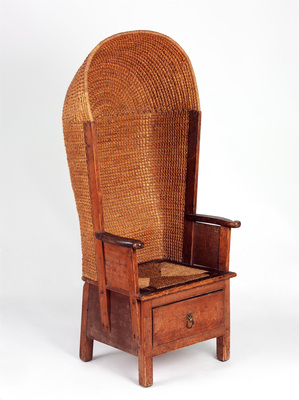
Orkney Chair, ca.1890
This is a ‘hooded’ Orkney chair made of oak and oat-straw and sisal, with a drawer below the seat. The frame was made in David Kirkness’s workshop in Palace Street, Kirkwall and the chair back was made by crofting outworkers such as Robert and Lizzie Foubister of Tankerness, Orkney. Though of vernacular heritage, the Orkney chair was standardized by Kirkness to four advertised designs – the Hooded Chair; the Gentleman’s Chair; the Lady’s Chair and the Child’s Chair. They were made in white deal or pine which was stained either green or brown or in solid oak, which was fumed and oiled with brass and copper fixings and invisible castors. Rush seats were more expensive and the under seat drawers were also an optional and more expensive extra.
The Orkney chair seen here is a refined development, using wood sourced in the mainland and shipped in from Aberdeen, of a local style of chair that was made in a variety of shapes and sizes from a diverse range of materials. These were fashioned at home, often using driftwood to compensate for the shortage of trees, with seats and backs made of straw or reeds or other naturally growing plants that are found on the low lying, salty and wind-swept islands. Several examples of these vernacular chairs, some of peculiar construction, along with recent versions, can be seen in the museum in Tankerness House in Kirkwall and in museums elsewhere on Orkney. The V&A also features the Kirkness-made Orkney chair in its recently re-designed furniture galleries. They are still made today using the same hand techniques in a range of classic and modern designs.