
Metal Wares
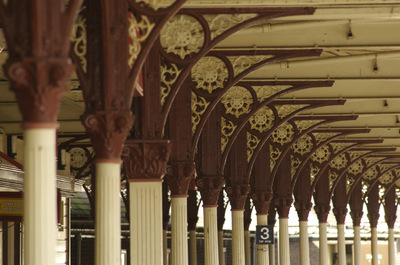
Architectural Ironwork at Aviemore Station, ca.1898
This is a photograph of the cast-iron columns supporting the platform buildings at Aviemore Station in the Scottish Highlands. Each column is topped with a cast iron capital decorated with scrolling volutes and Corinthian-style foliage. The roof’s supporting spandrels contain wheel decorations (roundels) and inserts of typically Victorian-style scrolling stems. Cast iron was a defining material in the architecture of Britain’s railways where it was used to build the essential infrastructure of footbridges and engine sheds, but also, as here, to give an ornamental flourish to otherwise basic station structures. Victorian design borrowed from a range of historicist, oriental and floral styles so cast-iron’s strength and adaptability made it the perfect material for decorating street and public architecture.
Aviemore was originally built for the Inverness and Perth Junction Railway in 1863, but was updated at the end of the century when the line was extended through Carrbridge. It is the largest station, except for Inverness, on the Highland Line. Aviemore’s engineer William Roberts worked on six buildings for the Highland Railway including the remodelling of Aviemore in 1898. His other stations include Brora, Newtonmore and Kingussie, the latter in particular shares stylistic characteristics with the platform buildings seen in this photograph.
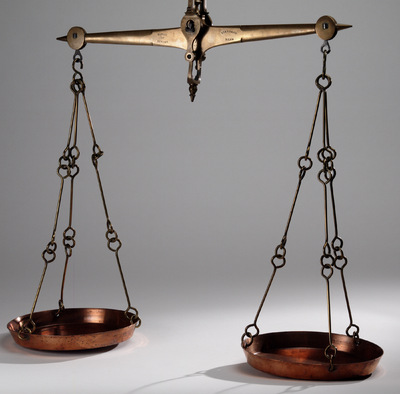
Balance Beam and Weight Pans ca. 1830
This bronze and copper weighing instrument, made using a combination of metal casting and beating, was typical of the sort of equipment kept by burgh officials to ensure fair trade within the town through the periodic testing of weights and measures in markets and shops. This balance beam, designed to measure a standard seven pounds, belonged to the Royal Burgh of Dunbar in East Lothian and was made by the small firm, J. White & Sons of Auchtermuchty. Each burgh would own a range of standard weight checking devices. This one can be held by hand and was probably used for testing weights employed by grocers or butchers for sales of butter, cheese or meat. The Burgh of Dunbar purchased several balances from J. White & Sons in the nineteenth century.
Scotland as with much of Europe used a variety of local weights and measures before the nineteenth century, with traders relying on printed guides for converting from one measure to another when trading across regions. The role of town council officials in regulating fair trade for the benefit of local communities extended to rights of inspection of weights and measures. Fair trade within localities was not however conducive to efficient long distance trade. The Highland Society of Scotland under the guidance of Sir John Sinclair was so concerned at the implications for the economy that it commissioned a report into Scottish weights and measures in 1813 and in 1814 the Glasgow Chamber of Commerce petitioned Parliament for standardization.