
Buildings
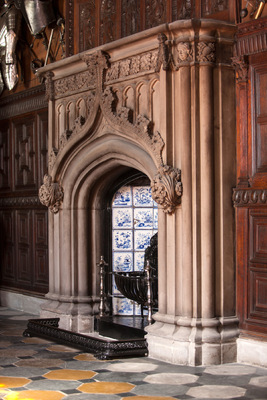
Carved fireplace at Abbotsford by the Smith Brothers of Darnick, ca. 1822
This carved pink sandstone fireplace was made by the Smiths of Darnick, a local building firm that was responsible for much of the work at Abbotsford, the house of Sir Walter Scott in Selkirkshire in the Scottish Borders. It is in a medieval ‘Gothic’ style, decorated with a variety of motifs including angels and thistles and the stone is from a nearby quarry. The fireplace is one of the first features that visitors to Abbotsford see as they come through the front door into the oak-panelled entrance hall, with its stained glass windows, ceiling painted with heraldic devices and displays of arms, armour and antiquities. The design for the fireplace is based on the so-called ‘Abbot’s Seat’ at nearby Melrose Abbey, which also features in an early Walter Scott poem, The Lay of the Last Minstrel. The sculptor was John Smith of the Darnick family, who also executed other decorative stone work at Abbotsford and carved a portrait statue of Scott’s favourite deerhound, Maida. His most famous work is the red sandstone statue of William Wallace at Dryburgh Abbey, undertaken for the Earl of Buchan. In addition to the Abbotsford building, the Smiths of Darnick were famous bridge designers and builders mostly on the River Tweed and its tributaries.
Sir Walter Scott, Edinburgh-raised but who knew the Borders well from childhood, built his Selkirkshire house around an existing farmhouse, spending about £25,000 on the project (the equivalent of two million today) over about ten years from 1813. The house was a tourist attraction during his life time and he died there in 1832. It was a celebration of all things local from the materials used in the construction, to the use of local craftsmen for the stone and wood work and the design references to buildings and places in the Borders of Scotland. The name ‘Abbotsford’ was an invention, which evokes the idea of the nearby Melrose Abbey and also makes reference to the river Tweed, on whose banks the house is sited. Abbotsford, in the building itself, the architecture and design features and its historic collections, was a pivotal contribution to Scottish antiquarian material culture.
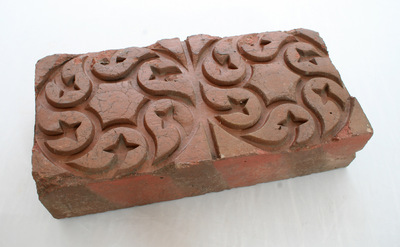
Pavement tile made at the Sanquhar tile works, ca. 1890
This pavement tile was made at James Brodie’s brick and tile works in Sanquhar, Dumfriesshire. It has a geometric surface pattern comprising two wheels of raised clay with indents designed to channel water away from the centre of the tile. A ‘blue’ version coloured with the iron oxide found in local carboniferous coal measures has also survived in Dumfriesshire Museum’s collections.
Paving tiles were a niche area of production of the Scottish brick-making industry which, according to Bremner’s, The Industries of Scotland, employed in excess of 4000 people across 122 manufactories in the late 1860s. Sanquhar’s potteries developed from its coal-mining industry, which was founded in 1792 when the Duke of Queensbury began to exploit the coalfields on his estate. The red marls and clays that lay on the upper part of the shallow coal measures to the north of Sanquhar provided a ready source of natural materials for brickmaking, and the character of Sanquhar’s clay made it particularly suitable for making the hardest and most durable type of brick. Trends in agriculture from mid-century set a demand for specialist drainage bricks that became a key area of the industry, including at Sanquhar where Brodie’s brick and tile manufactory had opened in 1852 under the management of George Cleunel.
Bricks and tiles were made by forming clay into wooden moulds shaped to include indentations (‘frogs’) to economise on clay, or by impressing patterns into the surface of pre-moulded bricks. Pressed bricks had increased density that made them heavier and more enduring. When pressed with a raised pattern they provided a decorative and functional surface. Various steam-driven machinery was introduced to streamline the brickmaking process from the 1810s but even large manufactories were dependent on men to oversee the pressing technologies. In 1901 there were 90 men listed in Sanquhar as specialist brickmakers.