
Textiles
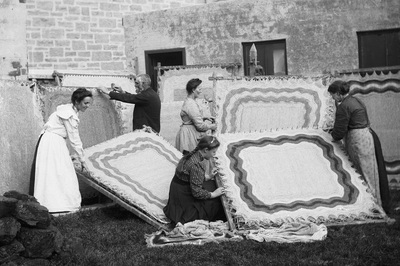
The Petrie Family, dressing shawls, Shetland, ca.1910
This is a photograph of the Petrie family dressing lace shawls on Shetland in the early years of the century. Shawls were hand-knitted by women of the island then shipped by merchants or middlemen to be sold on the mainland. ‘Dressing’, sometimes known as ‘blocking’, was usually the last stage of Shetland shawl production. It refers to the process of dampening the finished shawl before pinning it with gentle tension to a prepared frame and then leaving it to dry in the stretched position. This process opens the lace construction of the knitting, creating a flat, evenly-tensioned surface that shows the full beauty of the shawl and its patterning. Shawl pattern names often reflected the landscape of the Islands, for example, ‘old shale’ and ‘print o’ waves’ were frequently-used Shetland lace patterns.
P.E. Petrie was listed in the Mansons’ Shetland Almanac Directory as a ‘cleaner and dresser of Shetland hosiery’ at Albany Street, Lerwick, though, as this photograph shows, several female members of the family were involved in the process of preparing shawls for selling. Historian Lyn Abrams has noted that dressers worked for either the knitter or the selling merchant, and that a hand-knitter could do business with a merchant or sell her goods directly to island visitors or travelling salesmen. When selling to merchants, shawls were often paid for in essential provisions rather than money with merchants providing the wool to island women who knitted shawls and hosiery in between their other crofting duties. Miss Algy Peterson grew up in a two-bedroom cottage in Shetland, and when interviewed in 1902 about her family life and childhood recalled that her mother knitted shawls in between other tasks of working on the croft or gutting herrings.
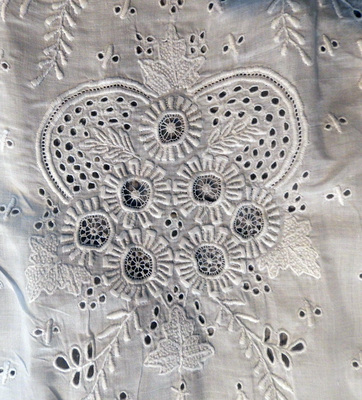
Whitework Christening Gown, mid-19th century
This detail of a 19th century christening gown is a typical example of Ayrshire work consisting of firm satin stitches on fine cotton cloth with areas of cut-out cloth which are filled with fine, needlepoint lace stitches. It has a simple design of flowers and a trailing vine worked in a combination of solid satin stitches, curved lines of ‘laddering’, and overcast eyelets that anchor two types of needlepoint fillings. Traditional whitework items included sleeves, chemisettes, baby’s robes, bonnets and trimmings, though changing trends in nineteenth-century fashion also dictated different styles and products. For example, over 200 designs for fashionable embroidered collars were copyright-registered by the firm of Sharps & Co. of Paisley between 1843 and 1844. Irish lace was expensive and worn by only the wealthiest women whereas whitework offered a pleasing, affordable alternative.
The whitework industrywas introduced to Ayrshire in the 1820s, with five principal producers listed in the Ayr Post Office Directory by 1830. Its production increased steadily over the next two decades. The New Statistical Accounts of Scotland (1834-45) show that there were nineteen parishes in Ayrshire alone where women were working as muslin embroiderers or ‘flowerers’. The intricacy and delicacy of the work shows the skill of its makers, though the notion of whitework as a congenial cottage industry fails to recognise the scale and speed of its manufacture in the mid-nineteenth century. Outline designs were printed on cloth by Glasgow-based, ‘sewed muslin’ manufacturers who distributed them to Ayrshire embroiderers in a putting-out system of production. Each design was sent with information on how long the embroiderer had to complete it and what rate they would be paid.