
Glass and Ceramics
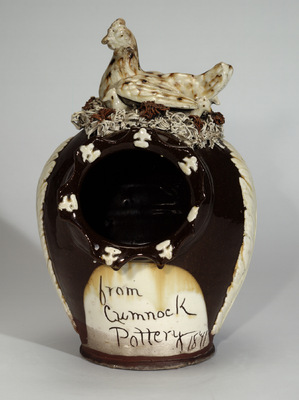
Saut [Salt] Bucket, ‘From Cumnock Pottery, 1871’
This redware russet brown, black and cream glazed kitchen ceramic is of an ovoid or egg-shaped form with applied feathered decoration on the sides and a moulded brown-speckled hen and four chicks sat in a straw nest on the top. There is a round hand-sized aperture towards one side embellished with chick motifs, below which is a white plaque decorated with the words ‘from Cumnock Pottery 1871’ rendered in a simple free-style hand.
Salt containers such as this, for standing alongside a cooking stove, have a covered top to keep the salt dry and free from kitchen debris. They are variously known as salt crocks, vases or pigs, the latter an old Scots word for a jar or pot made of earthenware. The nesting hen was a popular whimsical motif in eighteenth and nineteenth century pottery design, seen frequently in early Staffordshire-made egg baskets or tureens and adopted in Scotland from the mid-nineteenth century. The Cumnock Pottery made many styles of salt containers, usually embellished with ‘couthy’ sayings, but they are mostly plain in form.
The pottery was founded in 1792 on the Dumfries House estate of Lord Bute with potters brought in from Glasgow. Much of the early output comprised basic tiles or simple pots. The fortunes of the business were transformed in the 1850s when the coming of the railway widened the market and the output was extended into more decorative domestic wares, colourful flowerpots, holiday souvenirs and commemorative wares to mark family occasions such as marriages and birthdays.
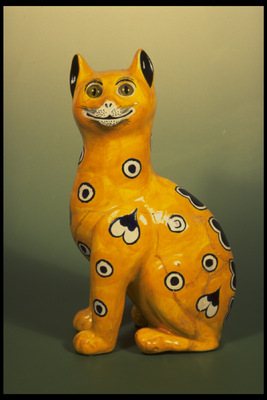
Wemyss Ware Cat, ca.1890
This ceramic cat has glass eyes and is decorated all over with yellow glaze and a pattern of blue hearts and roundels. It was made as part of the Wemyss Ware range at Robert Heron & Son, Kirkcaldy, though its characterful stance and distinctive decoration shares characteristics with ceramic cats made by Emile Galle of Paris in the 1870s. Wemyss Ware was particular to Heron’s Fife Pottery where it was introduced as a hand-decorated range in around 1882.
Robert Heron was the last of three generations of the Methven family to run Kirkcaldy’s potteries. David Methven bought the works and clay rights to the Links Pottery in Kirkcaldy in 1776 and his son John bought the nearby Fife Pottery in 1827. It was this pottery that Robert Heron inherited from his mother Mary Methven Heron in 1887. Under his influence and with the painting skills of decorators brought specially from Bohemia, a clearly identifiable, hand-painted style was created for the wares produced at the Fife Pottery. An early advertisement described Wemyss Ware as “The Original Hand-Painted Pottery in Flowers, Fruits, Cocks and Hens”. This cat is a typical example of late nineteenth century decorative design that used vibrant oriental-style colours.
Wemyss Ware was named for the Wemyss family at the local Wemyss Castle, and its early shapes were informed by the ceramic antiquities held in the family’s collection. Two Fife Pottery vases, the ‘Lady Eva’ and the ‘Grosvenor’, were named after family members. Aristocratic patronage remained significant in helping Wemyss Ware to become a staple of Edwardian country house furnishing, and goods were displayed by arrangement at local fund-raising bazaars or in a special room at the pottery itself to coincide with visits from dignitaries and Wemyss family relations. Wemyss Ware was also sold in London through the pottery warehouse, T Goode & Co of South Audley Street, who had selling rights in England. A cat very similar to this one has been found impressed with ‘Wemyss Ware, R.H & S’ and stamped with ‘T Goode & Co’s insignia.