
Jewellery and Silverware
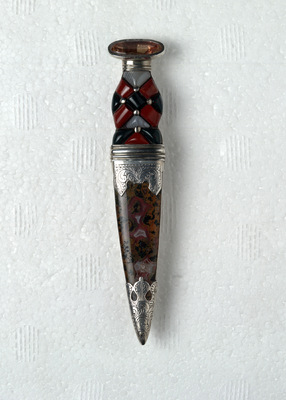
Agate Dirk, probably made by Peter Westren, Edinburgh ca.1858
This silver brooch set with a mosaic of native stones – jasper, bloodstone and agates or ‘pebbles’ – in the shape of a dirk, was probably made by Edinburgh jeweller Peter Westren. While small, the piece is highly crafted. A complex woven-style arrangement of native stones of the type found in Montrose make up the handle. The removable sheath is made from agate sourced from Burn Anne, and has been polished to curve around the small blade inside. Areas of engraved silver around the top and tip of the sheath mask the seams and joints of the stone and create light and sparkle, drawing the eye from the tip of the dirk through the white translucent areas of agate on the centre of the sheath, right through the handle and up to the crystal sparkling on top.
The firm of Peter Westren specialised in making distinctively Scottish jewellery from native stones at his premises on 19 West Register Street. The brooch was designed for women as a miniature version of the dirk worn by men as part of Highland dress. Objects like these were popular with tourists visiting Scotland, who purchased them as souvenirs. While this piece is of a high quality there were many cheaper copies of these popular ‘novelties’ circulating on the market at this time, prompting jewellers in Scotland to patent their designs. This piece has a registry mark indicating that the design was copyright registered 1858. A year before Westren registered a brooch of native stones in the shape of bagpipes, submitting a design illustration for inclusion in the Board of Trade Design Registers in London.
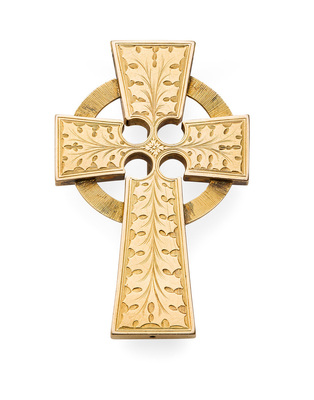
Kildonan Gold Cross, ca.1869
This is a cross brooch or pendant made from native Scottish gold, sourced in the Highlands during the gold rush of 1869, made and retailed by Glasgow jewellers D. C. Rait & Son. The cross is one of very few pieces which can be traced back to a short-lived but widely-reported gold rush in the county of Sutherland in 1869. An inscription on the back of the cross reads: ‘Scottish Gold, D. C. Rait & Sons’. The cross makes the most of the scarce native materials through its clever design. It was constructed from a number of panels of thin sheet gold soldered together to give the appearance of a solid piece. The cross shape with the ring around the intersection mimics ancient monuments on the Hebridean island of Iona – a popular motif during the Scottish-Celtic revival of the 1860s. Foliate decoration is engraved on the front: leaves grow down and across each panel around a central daisy, creating sparkle and light. Similar designs appeared in fashion magazines advising wealthy middle-class readers that the pendant should be worn suspended from a black velvet ribbon tied at the back of the neck.
D. C. Rait & Sons were a respected jewellery firm who operated in Glasgow in one form or another from the 1820s until well into the twentieth century. In 1869, the firm was listed as ‘Goldsmiths to the Queen, Jewellers, Watchmakers and Silversmiths’, and operated from a fancy showroom at 34 Buchanan Street on Glasgow’s main shopping promenade. The goods inside the shop were of such high value that the owners reputedly had the walls and roof lined with iron plates. In March 1869 The Inverness Courier reported that Rait & Sons had ‘been active purchasers of Sutherland gold from the commencement of the discovery, and have assayed several specimens officially’. It noted that ‘these have ranged from 19 to 19¾ carats. Mr Robert Gilchrist, the original discoverer, seems to have been very successful of late at the Kildonan burn, and has supplied Mr Rait with a considerable quantity of gold during the last few weeks.’