
Wood
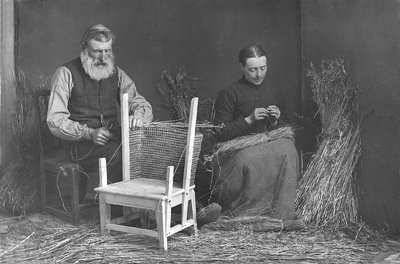
Robert Foubister and his daughter Lizzie, Orkney ca. 1920
This is a photograph of Robert Foubister, a crofter, and his daughter making a straw backed Orkney Chair. They are pictured preparing oat straw into coils that are then stitched into the wooden frame. Foubister appears frequently in the D. M. Kirkness Orkney Chair order book for the 1890s alongside other chair backers including John Coupland of Kirkwall. A typical entry for 1891 was for two chairs, one mid sized and one small, both backed by Foubister, who was paid 5s and 3s6d respectively, as ordered by Miss Spead ‘while on a visit at Berstane House’, with the chairs and bills sent to Wm H. Longbottom, Cavendish Road, East the Park, Nottingham, who Miss Spead was about to marry. Miss Maud Balfour of Berstane House was one of the first to place an order with Kirkness. Foubister is a common name in Orkney. A fellow craftsman ca.1860 was Thomas Foubister, a taxidermist in Kirkwall, but most of that name were crofters and fishermen.
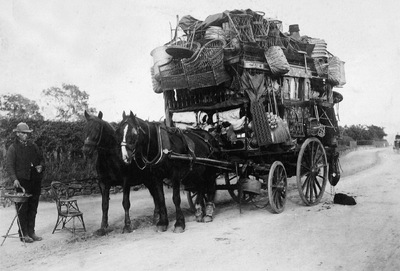
Basket Hawkers, Argyll, ca. 1900
This photograph of a perilously overloaded basket hawker’s cart, was taken in Argyll. The items displayed include wicker chairs for adults and children; baskets, brooms and laundry baskets; wicker tables, framed mirrors and umbrella stands; doormats and cane carpet beaters. Traveller communities in the Scottish borders and highlands were frequently associated with simple crafts such as horn spoon making or basket and brush making and mending. Cane and wickerwork furniture was particularly popular at the turn of the twentieth century. The source of these wares is unknown but may have included several institutions for the blind in Scotland that produced cane and basket work from the 1860s.
There is a rich tradition of local basket making in Scotland, using the materials available naturally or through agriculture ranging from straw, grasses or willow. On Shetland, the ‘kishie’ is a basket used in general agricultural work, especially carrying peats and muck. The Orkney ‘cubbie’, which was a general purpose basket of various sizes, was made by the same craftsmen who made the backs for Orkney chairs, using a variety of materials including straw, heather or rope. They were sold by D. M. Kirkness of Kirkwall along with his high fashion Orkney chairs. On Skye a wickerwork basket or 'crealagh’ was made from woven willow and was used to carry wool. Fishing communities were particularly noted for their basket work, from creels for carrying to lobster pots for catching. In the late nineteenth century there were several attempts by local patrons or Home Industry Associations to generate commercial production of woven straw and wicker goods in the highland counties. Reliance on imported materials diminished competitiveness and impeded growth in this sector.