
Textiles
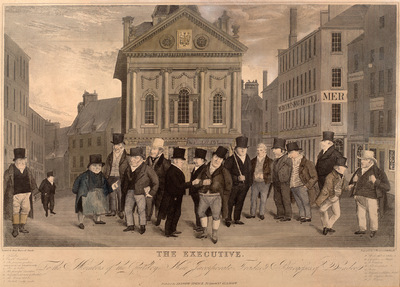
The ‘Executive’ of Dundee, by Henry Harwood, 1821
Scottish royal burghs were centres of craft manufacture and trade, governed by their merchants and artisans through the town council or ‘executive’. The privileges and responsibilities of craft workers were vested in incorporated bodies, known as trades houses, that regulated craft entry through apprenticeships, set wages and prices, supported the widows and orphans of its members and also had rights to sit on the town council. The city of Dundee had nine incorporated trades – the baxters or bakers; cordiners or shoemakers; skinners or glovers; tailors; bonnetmakers; fleshers; hammermen; weavers; and dyers. The character of these crafts, with their strong sense of community, reflected a local emphasis on textile processing and clothing manufacture. By the mid eighteenth century, with new technologies of production and expanding markets, the controls that were exercised by traditional craft elites through their trade houses were waning.
This is a famous print, reproduced in a number of versions, whose satirical intent is clear from the less than flattering representation of the individuals depicted. It was painted by a local artist, Henry Harwood and engraved in Edinburgh against a background of frequent accusations of town council corruption in Dundee and major disputes over control of the harbour.
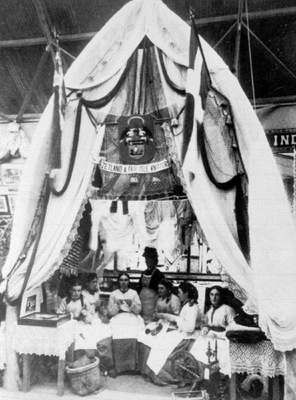
The 'Jaw Bone' Stand at the Edinburgh International Exhibition, 1886
This photograph shows the eye-catching Shetland Stand from the Women’s Industries section at the Edinburgh International Exhibition of Industry, Science and Art in 1886. It represents a group of women knitters as a community of craft workers, though three of the girls were from Mainland Shetland and three from nearby Fair Isle. The standing figure is Barbara Muir, sister of Margaret Currie who ran Currie & Co a truck-free shop buying and selling Shetland knitting from premises at Freefield Docks in Lerwick. The women attended the exhibition to raise awareness of the skills of Shetland’s knitters and to sell hand-knitted goods made on the islands.
The unusual shape of the stand reflects its construction from whale jawbones, prize remnants from another important Shetland industry. Shetland flags are displayed on either side of the Shetland coat of arms with its distinctive longboat motif and a horizontal banner reads ‘Zetland and Fair Isle Knitters’. The display includes a spinning wheel, a woven kishie (basket) perhaps to hold skeins of wool, and tables on each side of the stand that are draped with fine lace knitted squares. A large lace shawl is one of the many items pinned and draped above the knitter’s heads in this photograph.
Fishing and crofting were key industries on Fair Isle and Mainland Shetland but knitting was also economically important to the islands’ communities of women who supplemented their family income and sometimes fed their families on the proceeds of their handiwork. Girls were taught to knit as soon as they were old enough to hold needles, creating items of clothing - shawls, vests and socks – that could be sold to visitors or brokered through merchants. Cash payments for knitting were known but knitted items were more frequently exchanged for essential goods and provisions through Shetland’s cashless truck system.