
Metal Wares
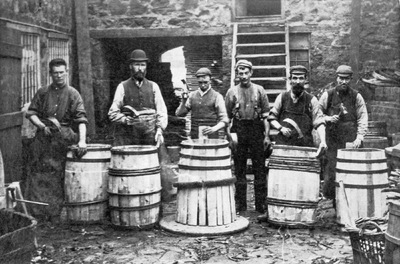
Coopers in a coopers' yard, Fife, 1880s
This photograph, taken by an unknown photographer, was probably taken near Anstruther in Fife some time in the last two decades of the nineteenth century. To the left of the image is a pile of ready-to-use staves stacked in the pend (passageway), spare metal hoops are piled against the wall to the right. Coopering demanded the ability to manipulate metal and wood to create sealed containers without the use of glue, nails or screws that could be used to store various perishable commodities. The integrity of the barrel and the preservation of its contents were entirely dependent of the skill of the cooper. The men in this image are of different ages, with the young man at centre likely still an apprentice, they can be seen posing with barrels in various stages of completion. Some are holding the specialist tools needed to shape and construct the ‘dry barrels’ needed for storing fish in airtight conditions. The cooper second from the left is holding a curved trussing adze of the type used to hammer the metal hoops on to the barrel.
The production of thousands of barrels was essential to Scotland’s fishing industry, so the scene in this photograph would have been familiar in many of Scotland’s east coast fishing towns from the 1820s to the 1930s. Coopers, along with the women who gutted and packed the herrings, were the land workers who transformed the bounty of local fishing fleets into a preserved, transportable commodity. In 1808 the Scotch Board of Commissioners of Herring Fisheries was established in order to regulate and improve methods of curing. Herrings were originally packed for storage at sea, but in 1819 a new ‘Scotch cure’ improved on its Dutch predecessor by allowing the packing of herring on land, so boosting the quantity of fish landed and the on-shore coopering trade. By the time this photograph was taken Shetland’s industry alone supported 459 boats, 4,484 men and production of 104,795 barrels per year.
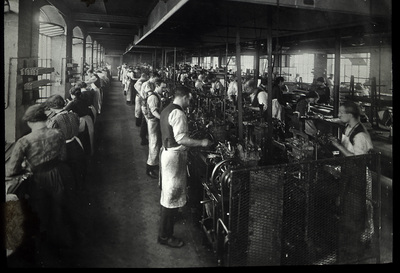
Workers in a Type Foundry, ca. 1910
This unattributed photograph of the interior of a type foundry, which is possibly in London but would have been much the same as those found in Edinburgh, including the firm of Miller & Richards in Chapel Street, shows men and women in the casting shop, with men casting the letters and women dressing the type of excess metal. The men, with their dirty aprons, are stood alongside hot and complex machines where the lead type is cast, whilst the women workers are seated for the less skilled work in a cooler position by the windows.
Type founding – the process of making the individual letters that are put together by compositors to make a page of text - began in Scotland with the Glasgow works of Alexander Wilson, who in the 1770s was responsible for the types used by the Foulis Press in the production of beautiful editions of the classics under the patronage of Glasgow University. The punch cutters and engravers who first worked in Scotland were mostly trained in London, but by c.1800 Wilson also employed a number of Scottish craftsmen including William Miller, his foreman, who set up his own business in Edinburgh in 1808. Miller joined with his son-in-law, Walter Richard, in 1842 and the firm of Miller & Richard of 65 Nicholson Street close to the University of Edinburgh, became the largest in Scotland employing over 500 ‘men and boys’ by the 1860s