
Buildings
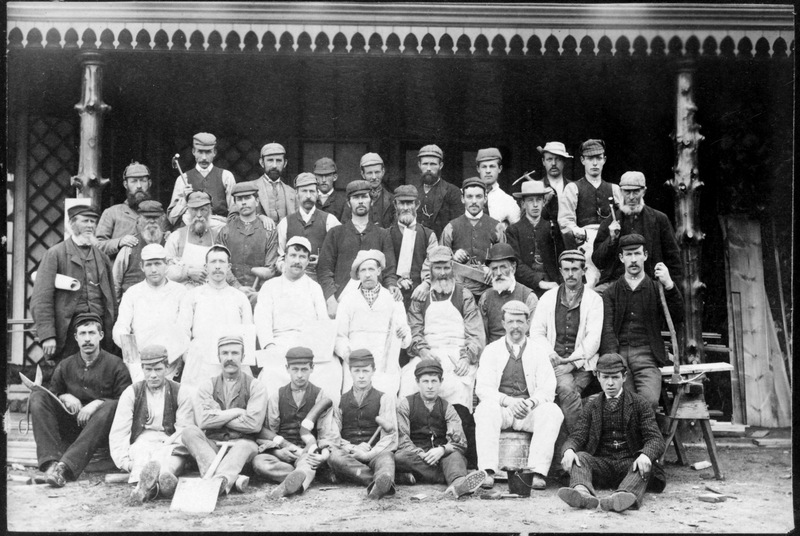
Craftsmen building Mar Lodge, Braemar, ca.1900
The banks of the river Dee in highland Aberdeenshire are dotted with castles and mansions mostly built in the nineteenth century as shooting lodges. They include Queen Victoria’s Balmoral and Mar Lodge, owned by the duke of Fife and his duchess, Princess Louise, which was destroyed by a fire in June 1895. The house contents were saved, but not the lodge, which was rebuilt shortly after.
This photograph of thirty-five men, with their trades and professions indicated by their clothing and tools, posed in front of Mar Lodge as it was nearing completion, shows pride in craft and community. The men seated on the ground at the front are plumbers, with one of them holding an impressive U-bend pipe and another displaying the soles of his hob-nailed boots. The man seated on the far left is holding tinsmith scissors. The suited young man with a watch-chain on the right is probably a clerk and the older man on the middle left with rolled plans under his arm is the builder overseeing the works. The men dressed in white are painters or plasterers. The second to back row has the carpenters, with their saws and planes displayed. Some of those in the image are estate workers, including a ghillie wearing a deerstalker hat and tweeds at the top left.
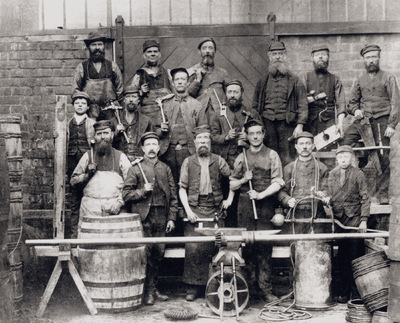
Workers at the Sandilands Chemical Works, ca.1910
Traditional skills were mobilised in the service of new industries as well as old ones. This photograph shows a group of the woodworkers and metalworkers employed at the Sandliands Chemical Works near Aberdeen. The range of tools suggests that the men and their apprentices were responsible for maintenance as well as running the factory’s machines. At the centre of the photograph is a blacksmith’s anvil and the boy to the right holds an elaborate bellows. A cooper stands to the left of the photograph next to a group of stacked barrels, while other men hold hammers, specially adapted wrenches or traditional woodworking tools.
Sandilands Chemical Works opened in 1848 to process the bi-products of the adjacent Aberdeen Gas Works, though by the end of the century it had diversified into the production of various organic chemicals. The works was owned and run by John Miller, one of three l brothers who were influential in Scotland’s early chemical industries. George Miller & Co ran the Rumford Street Oil Works in Glasgow, and James Miller the Forth and Clyde Oil Works also in Glasgow. All their businesses were dependent on local supplies of coal or gas and the availability of a capable workforce. In 1892 The Scotsman estimated that 1000 to 1300 men worked in the principal branches of Scotland’s chemical industries across five major works and that 220 men worked in the Clydesdale district alone.