
Glass and Ceramics
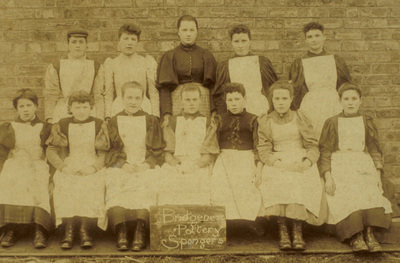
The Bridgeness Pottery Spongers, ca.1910
Production processes in Britain’s potteries were largely divided by gender until the twentieth-century. This is a portrait of a group of female workers at the Bridgeness Pottery in Bo’Ness near Falkirk. On the board in front of the group is chalked the words 'Bridgeness Pottery Spongers', showing them to be the young women responsible for hand decorating domestic ware in the pottery’s sponging department. The Bridgeness Pottery was founded by C.W.McNay in 1888 and operated in the Bo’Ness area until 1958.
Spongeware is the term used to describe pottery decorated by applying colour using a piece of natural sponge. It is widely considered to be a Scottish technique that was first used in the 1830s and then put into commercial production a decade later by Staffordshire potter William Adams. Sponging was an economic means of producing simple, two-dimensional patterns in one or two colours on inexpensive pots. The women in the photograph would have used carved pieces of natural sponge to apply repeat patterns to the unglazed pottery (biscuit-ware) before firing. Popular spongeware patterns included flowers, animals, ornamental lozenges and borders. Female workers were nearly always employed at the finishing end of production where they decorated wares using a variety of techniques. Hand-painting and gilding demanded specialist training at an art-school, whereas applying transfer designs and sponging were techniques learned on the job.
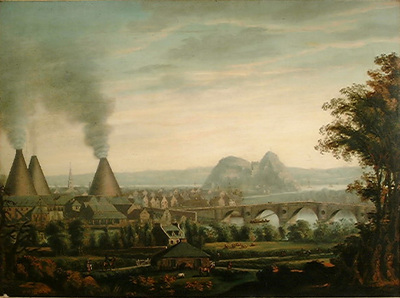
Dumbarton Glassmaking, ca.1820
This oil painting of the town of Dumbarton in west-central Scotland, taken from the west bank of the River Leven, is dominated by the three distinctive cones of the Dumbarton Glassworks. At the time the landscape was painted the town, of ancient foundation, had a population of c.3,500 people. The glass works, founded in 1777, was owned for most of its history by the Dixon family, who were local gentry landowners. They dominated the politics of Dumbarton, with several serving as Lord Provost. The glass works was located in Dumbarton because of the proximity to coal and sources of kelp from the Highlands (an ash derived from burned seaweed), which with sand formed the key ingredients of glass making. The firm was notable for two types of product – glass bottles and ‘crown glass’, the latter its main claim to distinction, giving employment to many skilled craftsmen. At its height, c. 1800-1830, the company supplied most of the high quality glass used in Scotland, with a focus on the Edinburgh market where it maintained an agent and warehouse. Crown glass was used as window glass and having highly reflective qualities is still made today using similar craft techniques for historic building conservation projects.
Crown glass was first perfected late seventeenth-century London and remained the main form of window glass through to the mid nineteenth century. It was made using a blowpipe technique, with the glass spun rapidly until a disk has been formed that was then cut into panes for astragal windows. The workshop, with its ovens for melting the glass, was a difficult place to work. Machine rolled plate glass replaced hand-blown crown glass from ca.1840.