
Jewellery and Silverware
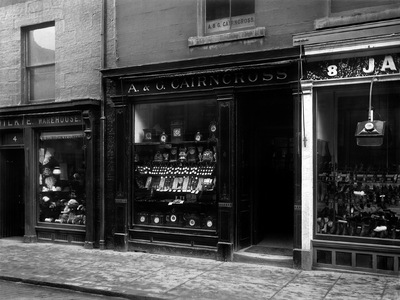
A & G. Cairncross Jewellers, Perth, ca.1890
This photograph shows the shop front of family jewellers A. & G. Cairncross at 6 St. John Street in Perth. Customers passing the premises of this firm in the centre of Perth could view a range of luxury goods through the large window. At the centre of the display, at eye level, were rows of watches, sparkling silver medals, necklaces, pendants, pins and rings. On the shelves above and below these luxuries for wear on the body were standing clocks for displaying on the fireplace, at the centre of the Victorian home. This selection of stock is fairly typical for a late-nineteenth century jewellery firm seeking to appeal to customers seeking gifts for special occasions like weddings. Presenting goods in an ordered way, lined up behind gleaming windows under an elegant sign, sent a message that the producer was knowledgeable, careful and trustworthy.
The firm of A. & G. Cairncross was established in 1869 by brothers Alexander and George, and later developed a reputation for the production of high-quality jewellery in Scottish pearls. The Scottish freshwater mussel, Mya Margaritafera, provided the pearls sourced from the river Tay that winds its way through the town of Perth, and further north in the Highlands and Hebrides. The gems were distinguishable for their bumpy and irregular shapes, and for their distinctive earthy hues; colours ranged from creams through to yellows and browns, silvery light-greys through to dusky pinks and lilacs. These unusual shapes and colours were understood as a sign of wild origins. The Scottish pearl became increasingly valued as the natural product of a living landscape and as an antidote to the mass-produced goods that proliferated during the late-nineteenth and early-twentieth century. A. & G. Cairncross thrived during the first decade of the twentieth century, and moved to a larger showroom at number 18 St. John Street around 1913, where the firm (though no longer in family hands) still operates.
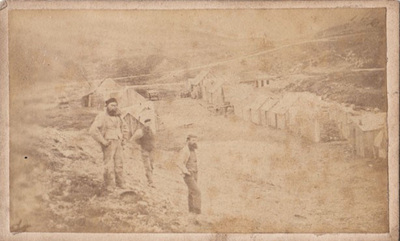
Gold Mining in Kildonan, Sutherland, 1869
At the peak of the Kildonan Gold Rush in March 1869 over 600 men travelled to the Highland districts of Suisgill and the Kildonan Burns in the hope of making their fortunes. The three men in this hazy photograph, which was probably taken by photographer, Alexander Johnston, from Wick in Caithness, are standing in front of the huts and tents that formed temporary living quarters in the landscape beneath the Sutherland estate hills at Helmsdale. This make-do, shanty town known in Gaelic as Bal an Or (Town of Gold) was home to a transient workforce of hopeful gold prospectors between January and December and 1869.
The history of Sutherland gold began when a nugget of gold was found in the River Helmsdale early in the 19th century. Fifty years later, native Kildonan, Robert Nelson Gilchrist, recently returned from his successful gold-mining venture in Australia, was given permission by the duke of Sutherland to survey the river’s burns and tributaries. Gilchrist’s efforts revealed enough gold to trigger a wave of newspaper reports and a short-lived escalation of mining activity. The Kildonan waterways yielded relatively little saleable gold, yet stories of fortunes made in recent gold rushes in Australia and California fuelled the public’s imagination and their enthusiasm for stories of Scottish gold. The activities at Helmsdale were reported widely in Scotland and London most notably in an extensive article published in the Illustrated London News (May 29, 1869).