
Textiles
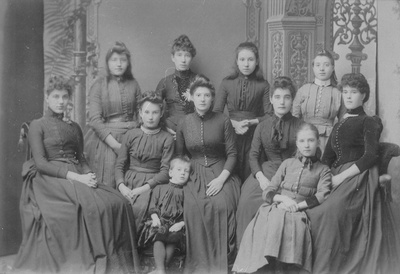
Dressmakers employed by Veitch of Peebles, ca.1890
This photographic portrait, posed in the studio of photographer G. Watson of the High Street, Peebles in about 1890, shows ten women described as ‘some of the dressmakers employed by Mr Veitch’, plus a small boy. Several are teenage girls, with their uncorsetted figures and long hair, who would have been apprentices to the trade; others are young adults. The figure in the centre, with the child leaning against her knee, may have been Mrs Veitch, co-owner of the establishment. The fashionably dressed figures seated on either side are notably good looking and have an air more commonly associated with the leisured elite than with working women. This was a feature of the bespoke dressmaking trades, whose appeal to customers was based on a cultivated veneer of gentility. The everyday reality of working life for the women involved was, however, very different, with long hours and poor pay the usual experience. It was only by setting up in business on your own account that the skilled dressmaker could hope to better her fortunes.
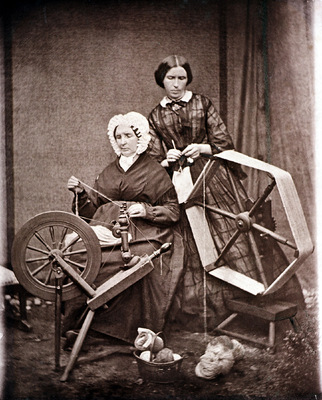
Mrs and Miss Ross of Tain, spinning and knitting ca. 1865
This photograph of Mrs and Miss Ross of Tain in north-east Scotland, taken by John Ross, an accountant in Tain and son of Mrs Ross, is titled ‘Household Industry in Tain Previous to 1850’. It shows the two women engaged in traditional female domestic crafts – spinning wool and knitting socks or stockings – which were also practiced commercially to supplement household incomes among the rural poor. Mrs Ross is dressed in the simple clothing of an elderly though well-off Highland cottager, with a frilled and starched linen ‘mutch’ or cap on her head and a practical cotton skirt and shawl. She may have dressed like this on an everyday basis, though as the mother of an accountant her middle class status would suggest otherwise. Miss Ross is fashionably dressed in a plaid silk gown over a crinoline. Despite the drapery in the background, the foliage on the ground suggests that the carefully composed photograph was taken outdoors.
Nineteenth century middle class and elite women were commonly represented in paintings and photographs with spinning wheels – and ornate spinning wheels, often antiques, were purchased as household furniture for elite drawing rooms from the 1880s. Processing textiles at home like this, though it was a technology long replaced by factories and machines, expressed an ideal of feminine industriousness – called eydence in Scots – and also evoked romanticised images of cottage life in the past and in the Highlands in particular that held a particular charm for Victorians. Mrs Ross sits by a Saxony wheel, which was widely introduced to Scotland from the mid-eighteenth century as the linen industry evolved, replacing the more portable and primitive distaff system of spinning. The wheel is powered with a foot treadle. Alongside her is a jack reel for winding the yarn. There is a basket on the ground containing balls of wool and finished socks.