
Glass and Ceramics
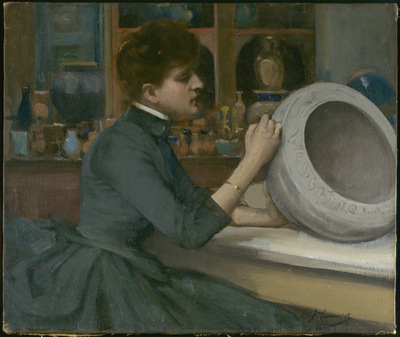
Alice Groom of Doulton & Co. at the Glasgow Exhibition, 1888
In this portrait by Sir John Lavery, titled ‘Woman Painting a Pot’, we see Alice Groom, ceramics artist, sat in the demonstration stand of Doulton & Co. at the Glasgow International Exhibition of 1888. She is working at a bench, painting or incising a large jardiniere, with pots in various states of completion displayed in the background and wearing a tightly-corseted blue-grey ‘New Woman’ styled dress with gold bangles and rings. Though the craft she is demonstrating was typical of her everyday employment the fashionable clothing and jewellery was not.
Alice Groom was twenty-four years old when this portrait was painted. In 1881, when listed in the Census, she was described as an ‘artist, painter’ born in Pimlico in London and was living at 3 Auckland Street in Lambeth in a household headed by her widowed mother, a ‘wardrobe dealer’ and two younger brothers, one of them later a tailor. Alice was almost certainly trained at the Lambeth School of Art, which had been founded in 1854 to teach applied art and design to working artisans. The School formed a close relationship with the nearby Doulton & Co. pottery works and from the 1870s had a curriculum designed to train young men and women for the pottery trade. Though there were more famous women associated with the pottery, in particular the sisters Hannah and Florence Barlow, pots identified as the work of Alice Groom are occasionally found in antique sales today.
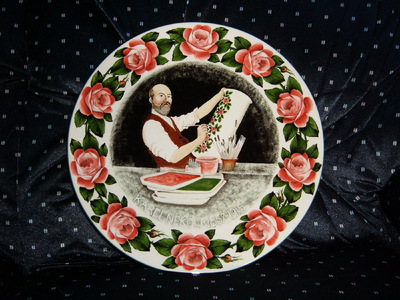
Karel Nekola (ca.1857-1915), Griselda Hill Pottery, ca. 2009
This modern, hand-painted plaque embodies the decorative spirit of nineteenth-century Wemyss Ware whilst depicting its most celebrated decorator Karel Nekola. The painter and ceramic decorator Griselda Hill acquired the Wemyss Ware ® trademark in 1985 when she came to live in Scotland. This commemorative plaque was commissioned specially for Kirkcaldy Museum and Art Gallery where it has held pride of place since the centenary anniversary of Nekola’s death in 2015.
Karel Nekola arrived in Fife from his native Bohemia in the early 1880s to take up a post at the Fife Pottery then owned by the Heron family. Robert Heron is thought to have travelled to the Continent specially to secure the services of talented decorators because Bohemia’s craftsmen were highly regarded for their skills particularly in the fields of ceramics and glass. Large-scale floral designs were Nekola’s signature style, including the distinctive cabbage rose pattern featured on this plaque. Its central portrait is based on a family photograph of Nekola in his workshop. He is seen decorating an umbrella stand which was one of a range of large-scale ceramics that were particularly associated with Nekola’s years at the pottery. Decorative jugs, ewers and basins, and ceramic jardinières were popular forms of furnishing in middle-class Victorian and Edwardian interiors, and the Fife Pottery specialised in producing cheerful ceramics that appealed to a broad popular taste.