
Metal Wares
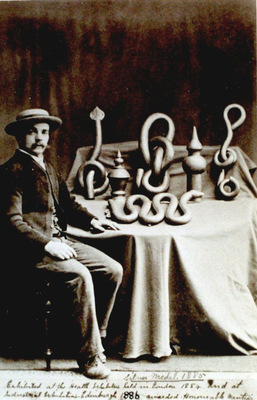
Tommy Ross, Plumber, Haddington, ca. 1885
This photograph of Thomas M. Ross (1860-1937) was taken in the studio of a professional photographer. It survives with a handwritten note that describes Ross's participation in several international exhibitions. Ross's note connects him to the London firm of John Smeaton, Plumbers and Sanitary Engineers of Baker Street and Castle Street, Strand, London, which exhibited Stand no.938 at the International Health Exhibition in South Kensington in London in 1884. In addition to Ross’s arrangement of decorative twists and knots, Smeaton’s stand showcased an 'Imperial Spray, Shower, Douche, Rose, and Wave Bath Complete’, a ‘Tip-up Lavatory Apparatus’, and a Bachelor’s Bath and Lavatory combined with wardrobe’. Such elaborate sanitary fittings are indicative of the novelty associated with indoor bathrooms that were the new innovation that signified middle-class status in housing in the 1880s.
Ross’s note says that his work was also seen at the Industrial Exhibition in Edinburgh in 1886 where it was awarded an Honourable Mention, and that it won a Silver Medal at an un-named exhibition a year later. Industrial exhibitions offered skilled craftsmen like Ross an important way of finding new clients and attracting commissions. They were regular fixtures in nineteenth century trade centres and Ross’s eye-catching work must have attracted attention in their visually competitive environments. Considerable skill and sensitive manipulation of materials were needed to maintain a uniform hollow within a contorted pipe. According to Ross’s note, the knot in the centre of this display was made up of a 12 feet length of 2 inch lead waste pipe and the others were twisted from 1 ½ inch and 1 ¼ inch lead pipe respectively. By the end of the century, machinery that used centrifugal force was used to uniformly, and perhaps more practically, shape the forms of domestic lead pipes.
Tommy Ross was a well-known plumber and key figure in Haddington society. He became Lord Provost of the town in 1918.
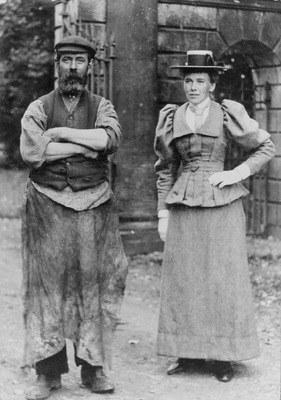
Robert Davidson, Blacksmith and his Daughter, Roxburghshire ca. 1897
A photographic portrait of Robert Davidson, master blacksmith at Woodfoot, near Hawick, Roxburghshire with his second daughter, Mary, stood outside the lodge house and gate entrance to Stobs Castle, dated 1887 according to record, but, from the costume worn by the woman, probably a decade later.
Robert Davidson, aged c. 50 years, is dressed in his working clothes of heavy stripped collarless cotton shirt and waistcoat, with flat peaked cap and leather blacksmith’s apron over trousers and sturdy but dusty boots. His shirt sleeves are rolled up to the elbows and he strikes a pose typically seen among men involved in the physically demanding metal and building trades, with brawny arms crossed high on his chest and a penetrating stare. The full beard and walrus-styled moustache, though fashionable at the time, add a patriarchal air. His daughter is stylishly dressed in a bell shaped walking skirt and matching jacket, with gigot sleeves, tight waist and a flared peplum. She has a white shirt with stand-up collar and tie. This ensemble along with the flat straw hat is characteristic of the style of dress adopted by the later nineteenth century ‘new woman’.
Robert was descended from a long line of Roxburghshire blacksmiths. His grandfather, father and elder brother, all named Walter, were the blacksmiths who occupied the Newmill-on-Teviot smithy a few miles south of Hawick for most of the nineteenth century. A country blacksmith such as Robert Davidson would turn his hand to many different activities, such as shoeing horses, mending and making farm or local workshop equipment and fashioning tools for use by other craftsmen, such as hammers, knives, files and chisels. The Stobs Castle estate, from which he rented the cottage and workshop attached to the castle lodge would have generated much of his work.