
Jewellery and Silverware
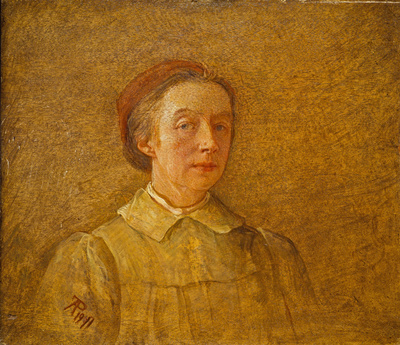
Phoebe Traquair, Self Portrait, ca. 1910
This self-portrait of Phoebe Traquair (1852-1936) was painted in oil on a mahogany panel between 1909-11. Traquair was a key figure in the Scottish Arts and Crafts movement and is perhaps its most well-known woman. Her work included jewellery enamelling, book illuminating and binding, embroidery, and mural painting. The portrait shows Traquair at the peak of her career having completed several large commissions and at a time when she was developing her small-scale decorative work. She began enamelling in 1901 using a technique that involved painting enamels onto copper plate, and in total produced over 300 enamelled works including the gold and enamel ‘Love Cup’ pendant designed as a special commission for the architect Robert Lorimer.
Born Phoebe Anna Moss in Kilternan, near Dublin, Ireland, in 1852, Traquair attended art classes at the Royal Dublin Society before moving to Scotland with her husband Dr Ramsay Traquair in 1873. She started her career preparing scientific drawings for her husband who became Keeper of Natural History at Museum of Science and Art in Edinburgh. Her early work was produced within the context of her family but after 1885 she began to take on larger works and public commissions. In 1888 she was commissioned by the Edinburgh Social Union (ESU) to produce a large-scale mural scheme for the Song School at St Mary’s Episcopal Cathedral. This was followed in 1893 by an even more ambitious mural commission for the interiors of the Catholic Apostolic Church Edinburgh.
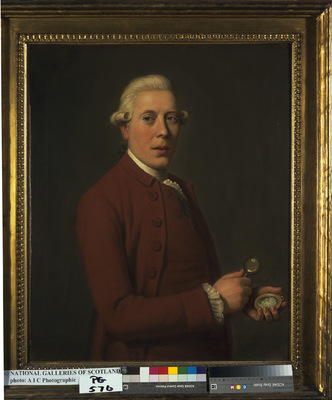
James Tassie, Sculptor and Gem Engraver, ca. 1781
This portrait of sculptor and gem engraver James Tassie shows him holding one of his famous cameos in his left hand and a magnifying glass in his right. The portrait is by David Allan, who trained with Tassie at Glasgow’s Foulis Academy. Tassie was a skilled artist who specialised in producing miniature portraits of historical figures and contemporary sitters in various mediums. As well as engraving medallions and gems, he moulded them in glass cameos like the one he is depicted holding here, which were worn as jewellery by elite customers. The making of a cameo involved many stages of skilled hand work. First, Tassie carved the portrait in wax using a series of fine tools, then made a relief mould from vitreous glass paste. That mould was then used to produce the final 3D portrait, again in vitreous glass paste. The three-dimensional portrait was then mounted on a stone or, in this case, ceramic backing before being placed into the setting, usually of precious metals.
Originally from Pollockshaws, James Tassie (1735-1799) trained in Glasgow at the Foulis Academy before moving to Dublin, where he co-invented a new form of vitreous glass paste. Tassie then moved to London, an established centre of luxury consumption, where he earned a reputation as one of the foremost producers of portraits on gems and cameos. He made work for London jewellers and wealthy private collectors, most famously Catherine the Great. The portrait communicates Tassie’s status and occupation through his luxury dress and the focus on his hands and eyes. He is depicted as a respectable gentleman wearing a fashionable wig and a smart three-piece suit in a rich red colour with a white linen shirt and neck-tie. His hands are engaged, holding a magnifying glass – an important tool for making miniature portraits, and a marker of knowledge – over a finished cameo.