
Metal Wares
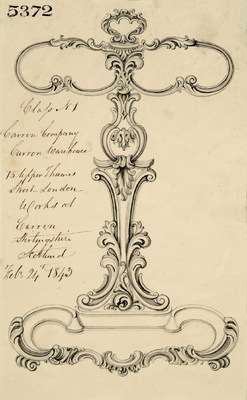
Umbrella Stand, Carron Company, 1843
This ink on paper design shows the shape and details of the cast-iron umbrella stand copyright registered by Carron Company at 75 Upper Thames Street, London and with works at Carron Stirlingshire, Scotland, on February 24th 1843. The design, which is typical of mid-Victorian taste, is highly decorative and shows the intricate moulding capabilities of the iron-casting process comprising a symmetrical arrangement of adjoining c-scrolls and almost no straight lines. It was one of over thirty-five designs registered by Carron Company between 1843 and 1863.
Carron Company was the first large-scale cast-iron smelting company in Scotland. Founded in 1759 on the banks of the River Carron it was established as a large-scale manufactory, with ammunition, architectural ironwork and decorative domestic wares all included in its early production. Emphasis on good design was a significant factor in Carron’s early success. In the 1770s the Scottish architects, Robert, James and John Adam became shareholders in the business, influencing the style of its decorative work and representing the firm’s commercial interests in London. Under their influence Carron supplied the beautiful, classical-style cast-iron ranges and decorative grates for which the company became renowned, many of these can still be found in the private and public rooms of country and town houses in London and Scotland. Carron’s Adam-styled ironwork can also still be seen in the balconies and railings of Edinburgh’s New Town.
Carron Company was formed as a joint endeavour between chemical manufacturer John Roebuck, Birmingham businessman Samuel Garbett, and William Cadell who was an ironmaster, shipowner and merchant of Cockenzie. In its early years it was dependent on the skills and knowledge of a workforce brought from the iron district of Coalbrookdale in Shropshire, but its expansion allowed investment in local skills and new smelting technologies. By the late eighteenth-century Carron was fully exploiting Falkirk’s resources of iron-ore and labour.
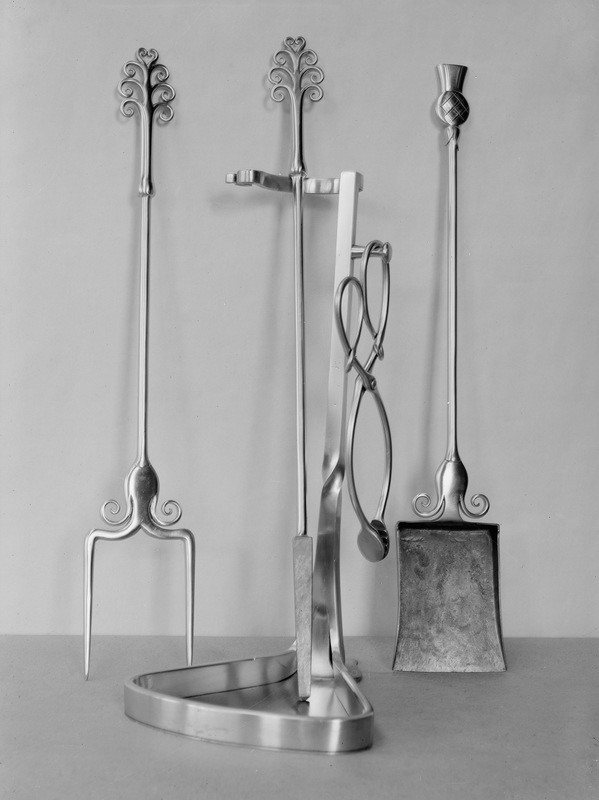
Fire Irons, Thomas Hadden, ca.1915
This set of burnished wrought iron fire irons in the Arts and Crafts style were probably made at the Thomas Hadden ironworks at Silvermills in Edinburgh to a design by Sir Robert Lorimer. The set consists of a small shovel, a fork, poker and fire tongs on a shaped stand with a tray for ash. A set such as this, which may have been made to match an ensemble of fire place furniture, including a fender and ‘fire dogs’, for a specific house commission, was practical for use when a fire was burning, but also decorative. Fire irons could also be made of brass and burnished steel but the implements used by servants for cleaning and setting a fire would be factory made and kept out of sight.
Wrought iron's association with the traditional smith rather than the industrial smelter led to renewed interest in its production at the end of the nineteenth century. A key characteristic of the Arts and Crafts movement was that its practitioners valued simple, unpretentious workmanship using traditional materials and techniques. Small, simply-styled items of fireplace furniture, light-fittings and door hinges allowed the material expression of traditional craft skills within the domestic scale and utility of the home.
Thomas Hadden (1871-1940) was born in Hamilton, Lanarkshire to a metal working family from Haddington, East Lothian. He trained at Howgate near Edinburgh and worked for James Milne & Sons in Edinburgh before starting in business in partnership with his brother who was a wood carver. His work was exhibited in the Arts & Crafts Society Exhibition in London in 1910.