
Jewellery and Silverware
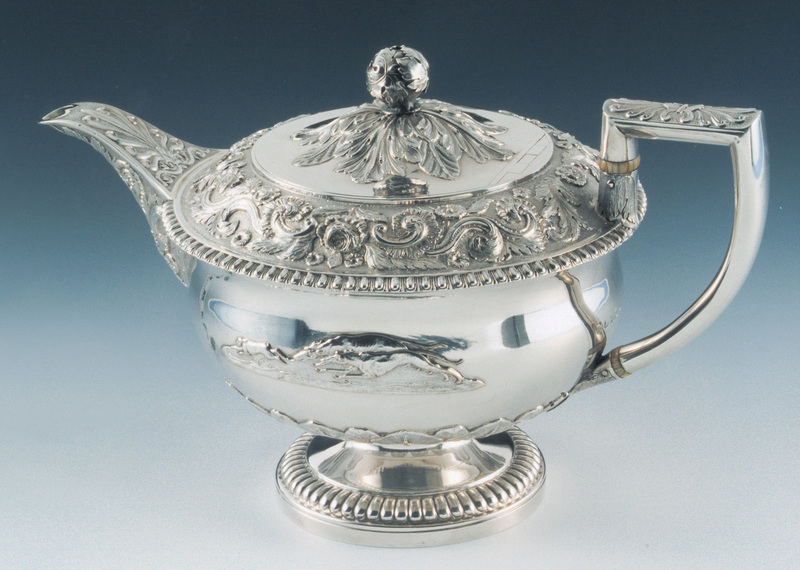
Silver Teapot, Robert Gray and Son, Glasgow, 1827
This round silver Rococo styled teapot has a domed top and is set on a base with a gadrooned band. A cast plaque has been applied to the side showing two greyhounds hunting a hare and the lettering ‘Ardrossan Coursing Club MCCCCXXVll’. It was made by Glasgow silversmiths, Robert Gray and Son. The teapot’s fashionable design with additional applied and engraved detail identifies it as a sporting trophy. The top, handle and spout are decorated with a swirling foliate and floral rococo-styled pattern. The NMS owns another silver hare-coursing trophy made by the same firm in 1823, this time in the form of a circular footed basked with handle decorated with a cast band of vine leaves and grapes on the inner edge, bearing the same cast motif of two greyhounds and hare and engraved detail of the prize winner. These wares, the teapot and the basket, were presumably also made without the additional decoration for domestic customers.
Robert Gray (c. 1755-1829) is regarded as one of Scotland’s finest silver makers, with a firm in Glasgow’s Trongate from c. 1776 and a broad output that included flatware, candlesticks, presentation cups and plates and the ubiquitous silver tea service. At the time the teapot was made, the firm was managed by William Gray (1781-1850), son of the founder, who was his father’s apprentice from 1794-1802. Robert Gray and Son trained a generation of fine silversmiths, many emigrating overseas, including Robert Hendery of Montreal, who completed his apprenticeship in Glasgow in 1837 and was in business in Canada by 1841
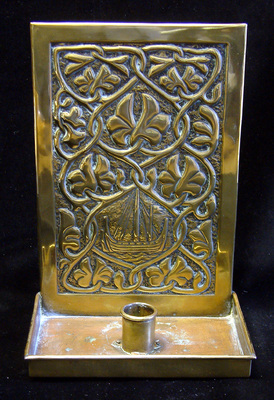
Brass Candle Sconce, Alex Ritchie, ca.1900
This brass candle sconce with embossed Celtic design of intertwined foliage and a central motif depicting a Viking sailing galley was made by Alexander and Euphemia Ritchie of Iona. It is one of a pair, which could be either free standing or fixed to the wall. The deep tray is designed to catch the melted tallow. The design, whist Celtic in its decoration, is similar in form to vernacular candleholders made for use in Highland crofter’s houses. It is made of brass, an alloy of copper and zinc, which is an easy to manage metal that has been used throughout history. It can be cast in moulds and hammered into shape and has an attractive gold lustre that enhances candlelight.
Alexander Ritchie (1856-1941) and his wife Euphemia Thomson (1862-1941) were Argyllshire born but trained at the Glasgow School of Art in the 1890s at the height of its fame as a centre for the Arts and Crafts movement. They settled in Iona in 1900, founding the business known as Iona Celtic Art. They enjoyed patronage and support from Lady Victoria Campbell, sister of the Duke of Argyll and an important figure in the Celtic Christian revival that focussed on Iona.
The Ritchies used brass for a wide range of goods including trays and plates, mirror and picture frames and small boxes as well as candle sconces. Their output of Celtic inspired wares, with frequent use of the sailing galley motif, included silver goods, particularly brooches and crosses and they also worked on wood and leather. From their shop on Iona, where Alexander also acted as custodian and guide for the Abbey, they sold a large array of mostly small goods to tourists and pilgrims. These were made in their local workshop, with additional input from a number of apprentices and assistants, though they also designed for a mass market with production from factories in England.