
Glass and Ceramics
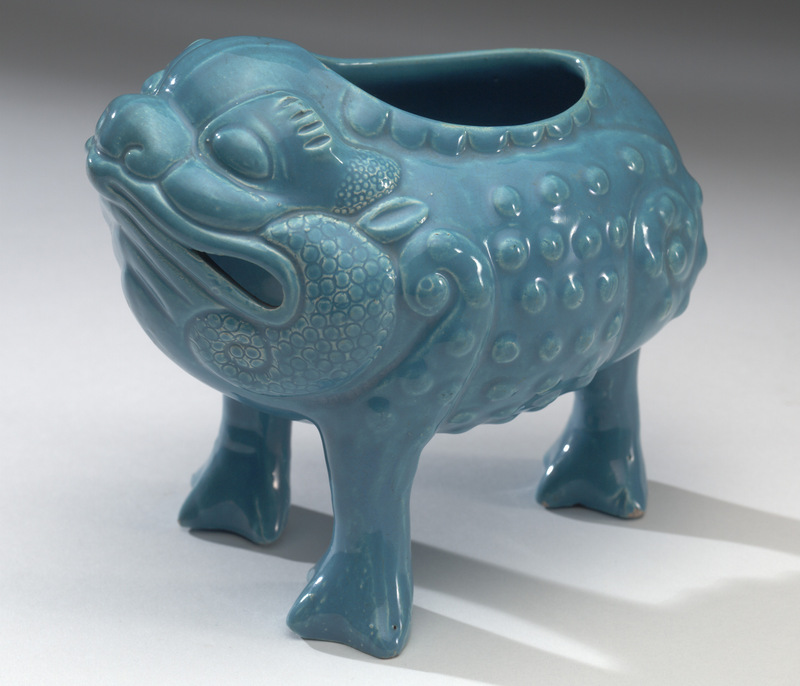
Glazed Earthenware Frog, Dunmore Pottery, ca. 1890
This turquoise glazed earthenware vase is shaped as a Chinese grotesque three-legged lucky money frog, a traditional symbol of prosperity and wellbeing. The Dunmore Pottery made it in a number of colours and in various sizes. An alternative version has the same frog in a seated position with its head raised and mouth open to hold flowers.
The Dunmore Pottery near Airth in rural Stirlingshire was established in the late eighteenth century to take advantage of a seam of local clay that could be fashioned into domestic wares and tiles. Peter Gardener (1834-1919), who took over his father’s business in 1866, was a gifted designer and clever entrepreneur, adept at exploiting international exhibitions and aristocratic patronage to forward his reputation. The firm remained a small concern with only fifteen skilled potters at its peak in 1881. The pottery made numerous ornaments to suit Victorian taste. It was well known for its vivid glazes, as in this example of bright turquoise. Oriental design was popular in the later nineteenth century as trade with the east expanded and the international exhibition movement exposed a wider audience to imports from China or Japan. One of the pottery’s best selling lines were the crackled red and turquoise glaze vases that caught the attention of Queen Victoria when first exhibited at Edinburgh International Exhibition of 1886.
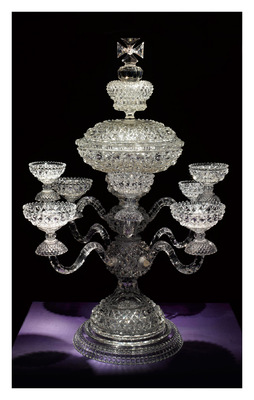
Glass Epergne, Holyrood Flint Glass Company, ca.1841
This cut glass epergne (table centrepiece) has 40 separate pieces. It is about a meter in height and was made by the Holyrood Flint Glass Company, Edinburgh, between 1840 and 1842, to mark the accession of Queen Victoria. An epergne was a glittering centrepiece for a dinner table and was often the largest and most valuable item of tableware on display. They were made of silver or glass or both, in multiple pieces, often embellished with coats of arms. Epergnes were sometimes made as wedding gifts or as commemorative presentation pieces to mark a special event. They were popular in the eighteenth century when they normally included bowls for candid fruits or nuts and they also typically held candles. In the nineteenth century, with changes in the way that meals were served and the introduction of oil lamps, the epergne was less likely to be used as a food container or for lighting effects and was either entirely decorative or held flower arrangements.
This epergne was made for a royal table setting and was used on state occasions at Holyrood Palace in Edinburgh. It was also displayed at the international exhibition displays that were mounted by the company – as in Edinburgh in 1886.
The Holyrood Glass Company,with factory premises at the South Back of Canongate and a shop in central Edinburgh, was one of several celebrated glass making firms in Edinburgh. In 1868 it employed over 200 men and maintained mass production alongside higher end craft output, with a group of about 40 skilled engravers or glasscutters and apprentices. The owner of the company mid century, John Ford, who took over from an uncle, was apprentice trained as a glasscutter, making a cut glass fruit bowl as his apprenticeship piece. The company also maintained a strong relationship with a glass engraving workshop, J J.H.B Millar, founded in the 1850s by a Bohemian entrepreneur with Bohemian workmen. J.H.B Millar was particularly associated with the development of the Scottish fern pattern design.